Quake 4
Thus, it was with great enthusiasm that I awaited Quake 4, the true sequel to Quake 2. Whereas the series took a multiplayer-only direction with Quake 3 Arena, Quake 4 would finally continue the story of humanity’s battle with the merciless Strogg. And so I begin this review. Honestly, I have a lot of mixed feelings about Quake 4. What it is, and what it could’ve been.
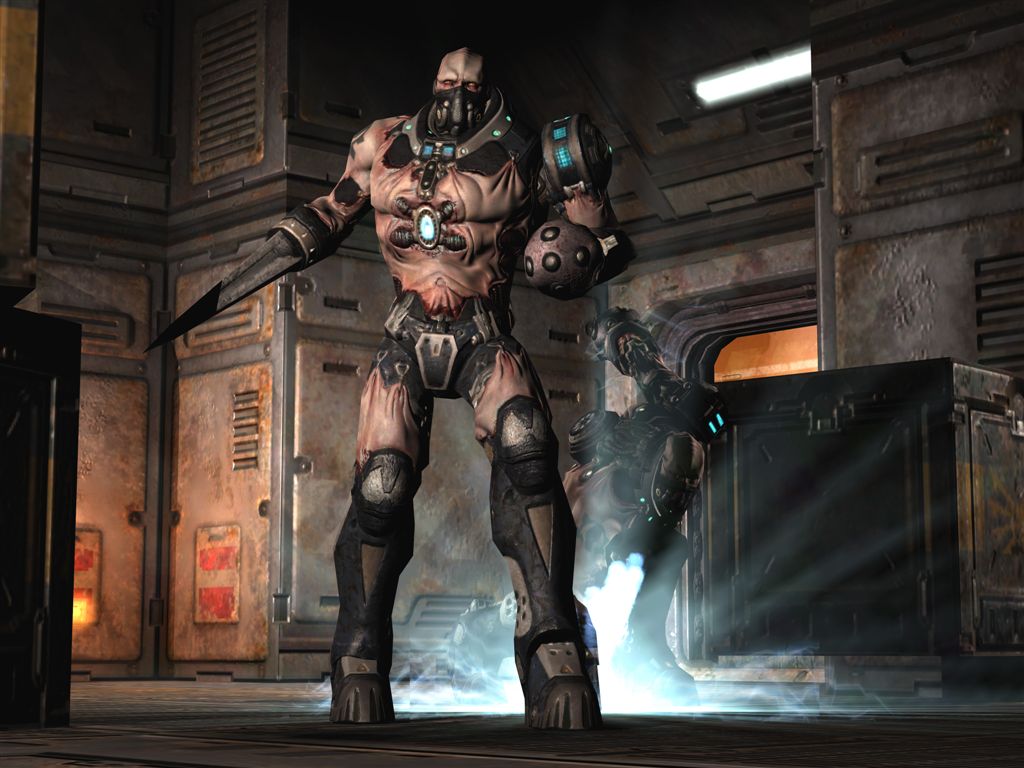
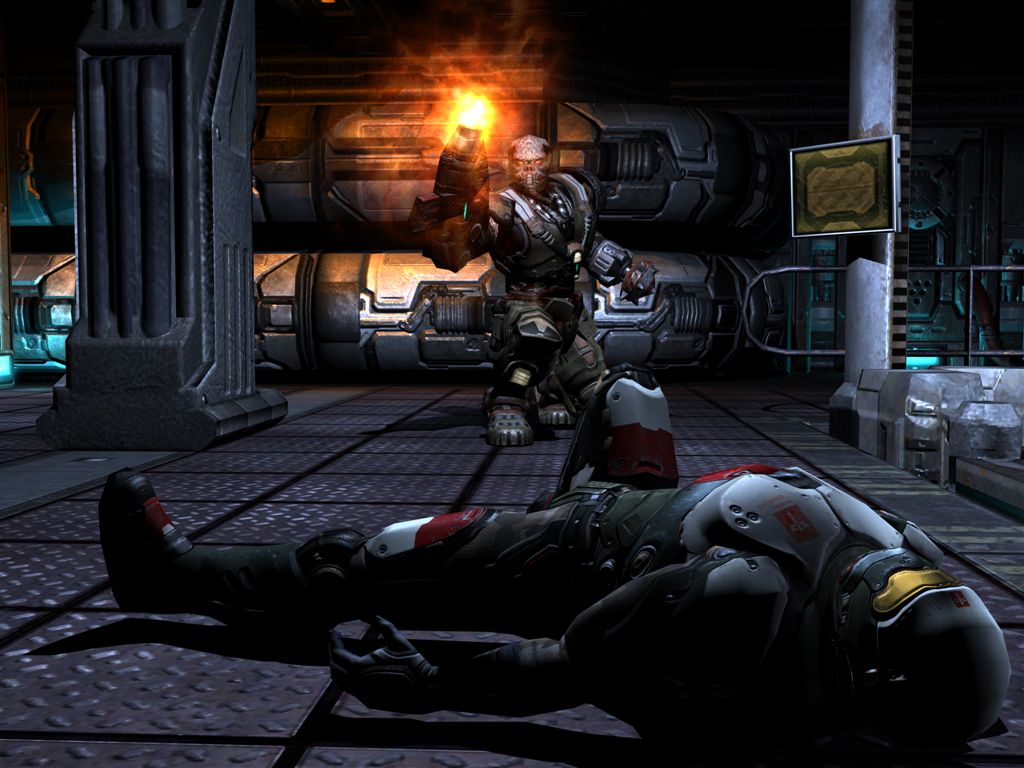
Right off the bat, the thing that grabbed my attention was how incredibly beautiful this game is. Beautiful, of course, in an H.R. Giger’s nightmare kind of beautiful. The grotesque, oppressive home world of the Strogg is a full step and a half more gorgeous than Doom 3, and that’s saying something. The reason lies in that Quake 4 has so much more visual variety than last year’s groundbreaking Doom remake. Outdoor environments are the biggest difference; Quake 4 isn’t a continual maze of corridors interspersed with a few large reactor rooms. The locales have some honest-to-god variation.
As you progress through the stages of the game, you’ll encounter a bio-processing facility, a power plant, a fetid sewer, and a gruesome “hospital” (more on that later). The amount of effort that went into the textures and modeling is truly amazing. If nothing else, Quake 4 is a work of art. From this masterpiece, though, rise a couple prominent problems. Quake 4 looks almost nothing like its predecessor. The grungy, filthy look and feel of Quake 2 are definitely present, but the actual art style of the game is nowhere to be seen.
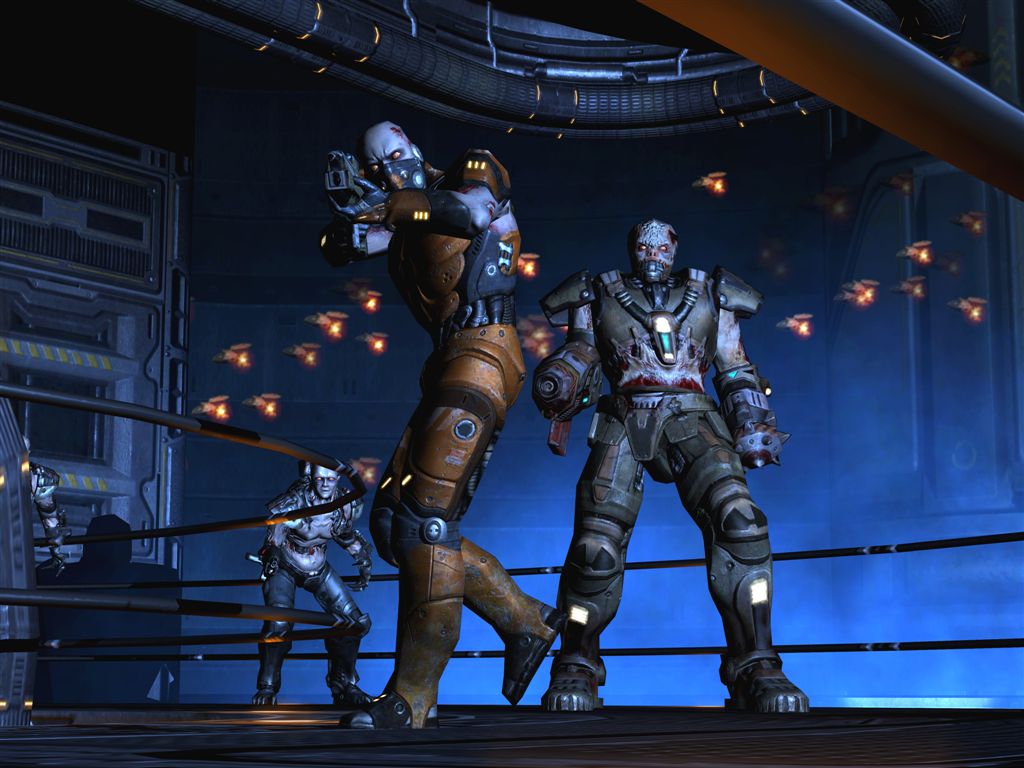
Weapons, enemies, even the armor of the marines all look completely different. Chronologically, Quake 4 takes place mere weeks after the events of Quake 2. So, in that span of a couple weeks, the Strogg and Space marines have apparently upgraded and restyled all of their equipment. About the only thing I recognized was the Strogg emblem pasted on walls and floors throughout the environment. I understand there is such a thing as updating a franchise. Metroid did this admirably with the 3D, first-person Prime games. Still, there must be enough of the past game elements to stir a sense of continuity and nostalgia within the player. I had no such feeling while playing Quake 4. To me, it felt like a much prettier Doom 3 that tried desperately to look like Quake.
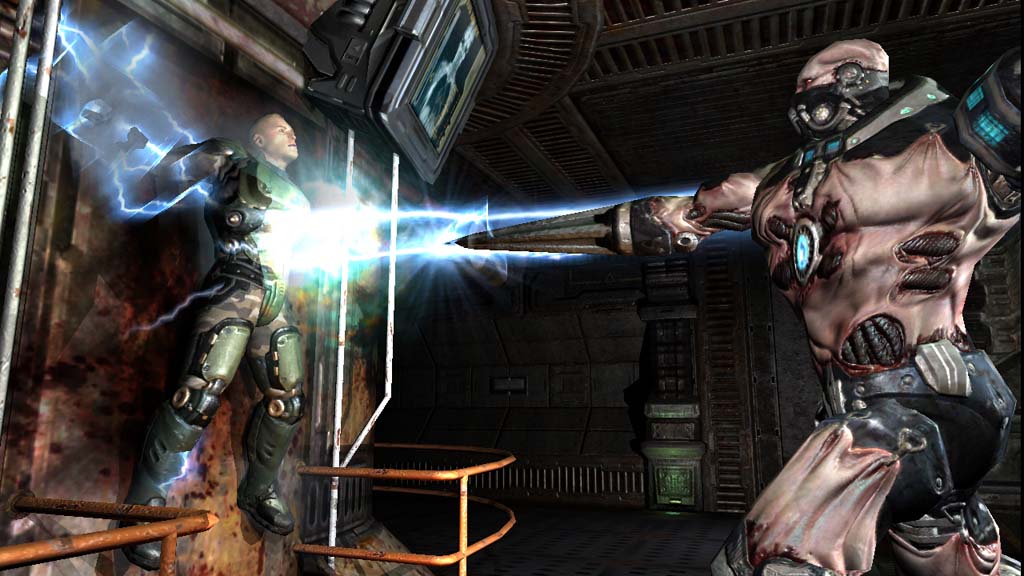
My only other issue with the visuals is a sequence about halfway through the game. It was known months before the game’s release that your character, Corp. Matthew Cain, would be captured and turned into a Strogg. The concept sounds intriguing at the outset, but the execution is less than stellar. The actual scene is rather disturbing. Immobilized, you are forced to witness the mutilation of Cain through his eyes. What’s worse, there’s another hapless marine on the conveyor belt in front of you, so you see first hand what’s going to happen to you, a few seconds before it does.Now I’m not the squeamish type. I like gory games with mature themes, but this scene was just over the top. To put it simply, there aren’t a lot of games that make me lose my appetite for pizza. And after the fact, the whole “assimilation” process doesn’t feel worth the pain that Corp. Cain is subjected to. Cain has a slightly increased capacity for armor and health, he can access Strogg health stations, and interface with a few previously restricted computers. The transformation plays a large part in the story, but only in the sense that Cain can now infiltrate areas that other marines can’t. He’s the obligatory “savior,” but scorned by some fellow troops because of his appearance. I would’ve liked some superhuman abilities, or at least a cool gun built into one of my arms.
Sadly, it’s only at moments like these that Quake 4 really becomes graphically revolutionary. Only when it gets incredibly gory and bizarre does it really stand out from the likes of Soldier of Fortune and Postal. The bad guys are all suitably unnerving to look at, and a few of the boss fights go for the gross-out factor—at one point you kill a boss by overfeeding it and rupturing its stomach. Still, it’s all for shock value, and artistic as it is, it doesn’t feel very much like a sequel to Quake 2.
Unfortunately, another incongruity comes in the form of gameplay. First of all, I don’t have any problems with the way Quake 4 plays. It is a very solid, satisfying first person experience. It has little to no flaws in how it moves, flows and transitions from one story arc to the next. It just doesn’t do anything new. It’s the same shooter you’ve been playing for eight years, just very, very eye-catching.
The weapons are well balanced, but to even them out, a few have been toned down. The nailgun is a shadow of its Quake 1 grandpappy. The Railgun, formerly a one-hit-kill badboy, has been significantly weakened. The Dark Matter Launcher is hardly a worthy replacement for the BFG 5,000, and the double shotgun is totally absent. I could forgive the tweaking and neutering of the arsenal, but the exclusion of my favorite double shotty of all time is unacceptable. The power disparity between the various guns isn’t as garish in multiplayer, but I’m getting ahead of myself.
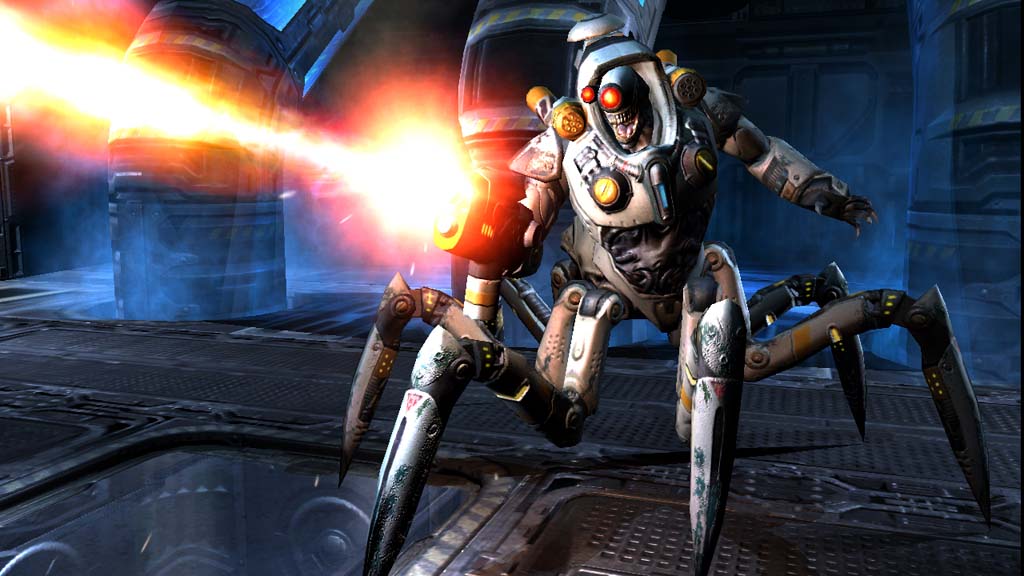
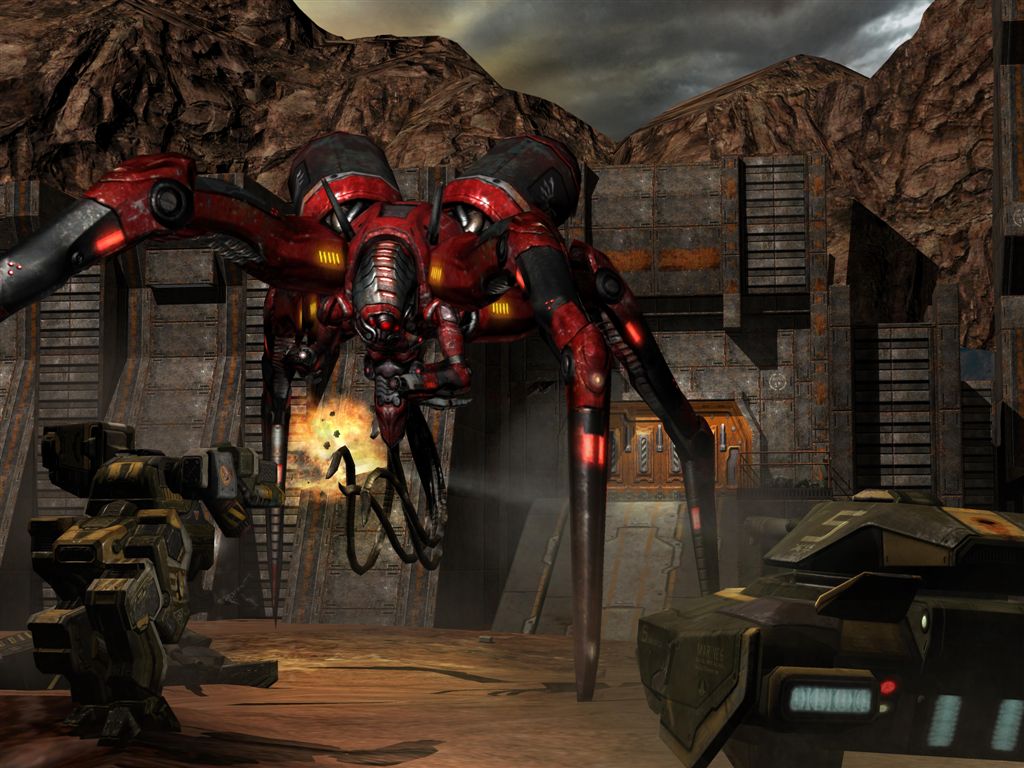
Another much-hyped feature was the ability to pilot tanks and walkers. I was really looking forward to these bruisers, but in reality the vehicle sequences would’ve been better served as rail levels. You pilot each vehicle only once, and the stages themselves are so linear that the free-roaming ability of the walker and tank is almost unused. You can stop, strafe, turn and aim, but I’ve seen it all before. It’s all much bigger than anything I’ve played previously—the battles with the giant spider mechs were jaw-dropping. Squishing tiny Strogg soldiers was also mildly amusing. I just can’t help but feel that GoldenEye’s tank levels did it better, and in 1997 no less. Again it’s a case of been there done that, just with vastly superior graphics.
One significant improvement is the addition of team-based combat. In several levels you’ll be accompanied by other marines, who possess impressive AI and contribute their fair share of firepower. Each marine has a distinct personality and sometimes ethnic background (the arrogant-yet-bumbling technician Strauss is especially entertaining). The troops’ personalities factor into how they fight as well; some will hold back and let you take point, while others will charge in blindly, guns blazing. In addition, medics and techs can replenish health and armor. Keeping them alive is sometimes your best chance for survival, but at other times the bottomless supply of health gets a little cheap. In short, the teammates make Quake 4 feel more like a war than its predecessors, and the one element that makes it really stand apart from Doom 3.The gameplay is on the cliché side, but the audio presentation is a surprising change of pace. Quake 1 and 2 featured heavy rock and roll, guitar riffs and driving beats. Quake 4 takes a more traditional approach, with a partially symphonic soundtrack. The orchestral pieces lend an epic characteristic that mixes well with the massive environments and overall war/conflict theme. Each piece is significant of the whole, and sets the right mood for each individual level. You have hectic, oppressive music for the trenches, creepy tracks during the stealthy exploration segments, and forceful, percussive arrangements to accompany the barreling vehicles.
The sound effects are noteworthy for their originality. Weapons sound heavier and more powerful than Doom 3’s arsenal, which came off as tinny and underpowered. Enemies make a good variety of screams and grunts, but nothing unique or exceptional. The effects are actually part of what makes Quake 4 so dissimilar from Quake 2; it sounds as different as it looks.
After a thorough play of Quake 4, it’s clear that the attention to the solo campaign was slightly stronger than that paid to the multiplayer. Id and Raven hoped Quake 4 would bring the Quaking community back together, and it has, but for how long is anybody’s guess. The unwelcome tinkering the guns received didn’t work well in the single player, but it definitely makes the multiplayer more enjoyable than Doom 3’s. No longer do matches dissolve into “the guy who gets the rocket launcher first wins.” You can theoretically become proficient with any of the guns, so the berserkers will develop skill with the automatics and the snipers will flock to the railgun.
That said, the magic of Quake multiplayer doesn’t feel as strong this time around. Arenas are well made for lots of players, some of the new weapons are novel to fight with, but there is a lack of variety. Character customization is disappointingly sparse, and you can’t use the vehicles from the solo game.
I really wanted to love Quake 4. There was so much potential, and a good bit of it has been realized. This game simply oozes production value, from the haunting environments to the majestic score to the tightly polished gameplay. This dog just isn’t doing any new tricks. The end result is a sequel that only mentions its predecessor in passing; on a whole, Quake 4 feels like Doom 3 in Quake’s clothing. Yes, it shares the same engine, but the presentation and gameplay have seen so little updating, we’re ultimately left with old school shooting at its best. This will appeal to the hardcore, but long time Quake fans looking for a revolution of their favorite franchise will be let down. Quake 4 does its job very well, and nothing more.
Rating: 8.4 Good
* The product in this article was sent to us by the developer/company.


About Author
I've been gaming off and on since I was about three, starting with Star Raiders on the Atari 800 computer. As a kid I played mostly on PC--Doom, Duke Nukem, Dark Forces--but enjoyed the 16-bit console wars vicariously during sleepovers and hangouts with my school friends. In 1997 GoldenEye 007 and the N64 brought me back into the console scene and I've played and owned a wide variety of platforms since, although I still have an affection for Nintendo and Sega.
I started writing for Gaming Nexus back in mid-2005, right before the 7th console generation hit. Since then I've focused mostly on the PC and Nintendo scenes but I also play regularly on Sony and Microsoft consoles. My favorite series include Metroid, Deus Ex, Zelda, Metal Gear and Far Cry. I'm also something of an amateur retro collector. I currently live in Westerville, Ohio with my wife and our cat, who sits so close to the TV I'd swear she loves Zelda more than we do. We are expecting our first child, who will receive a thorough education in the classics.
View Profile