Nintendogs
I’ll admit, writing this review was a little daunting. I mean, how exactly am I supposed to give my opinion of a non-game game? Well, being a closet Harvest Moon fan helps a little, but there’s still a sizable stretch between “farm sim” and “puppy sim.” So, I’ll give it the old college try...
Nintendogs, the big N’s latest unconventional title for their so-called developer system, initially defies defining. Many people who see me playing it on the bus or after work say, “Oh, that’s like those Tomogotchi things, right?” Well, they’re half-right. Nintendogs takes the embryonic pet-simulator concept introduced with such early tries like Tomogotchi and Giga-pet, and then hyper-develops it. Nintendogs is in essence what those primordial sims were trying to accomplish, and for one big reason: Nintendogs is based on a real animal, something we’re all very familiar with.
Let me explain further. Tomogotchi’s were popular as a novelty and among quirk-gamers simply because they were new and different. A blob of grayscale pixels that roughly resembles a cute little beastie will appeal to the offbeat crowd, but non-gamers won’t get it. Here again is Nintendo’s philosophy of broadening the market. They’re expanding an idea with a lot of promise by marketing it to people who have never played video games before, and it’s working.
The funny thing is, I’m as enamored with Nintendogs as my ten-year-old sister is, and I hope I can explain why in this review. I have an inkling that it’s because puppies are just one of those things that are practically irresistible to any human, unless you happen to really hate dogs. Puppies are adorable, soft, cuddly and loyal, and I’d better end this sentence before I need to take an insulin shot. The fact is that Nintendogs recreates the feel of man’s best friend so accurately, you’ll be instinctually drawn to these virtual canines as you would a real dog.
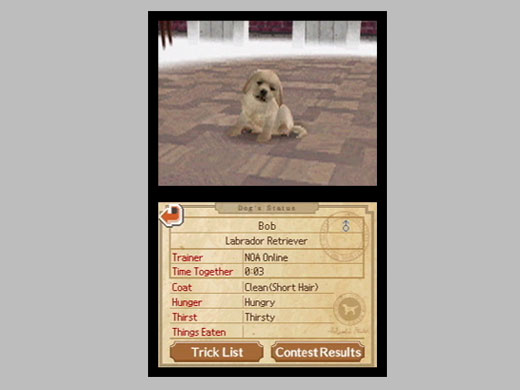
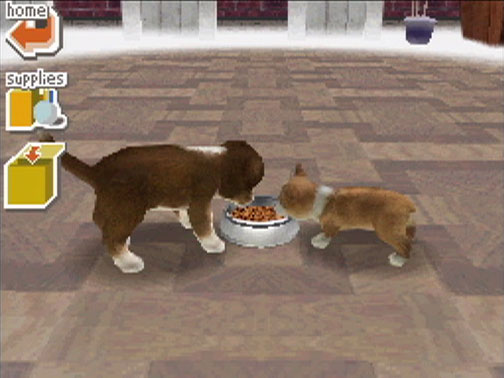
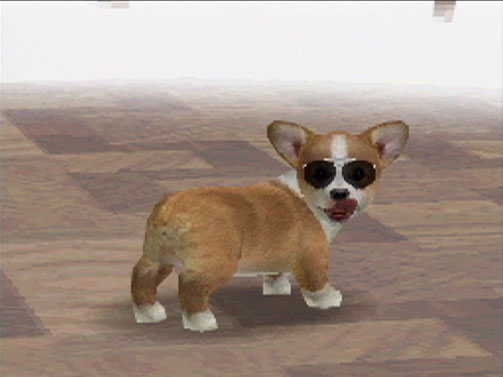
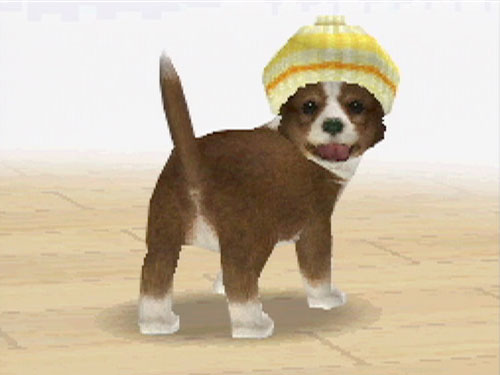
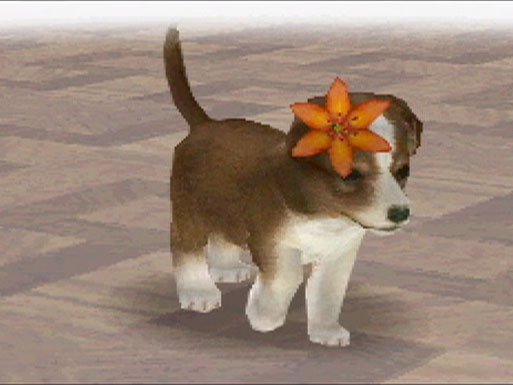
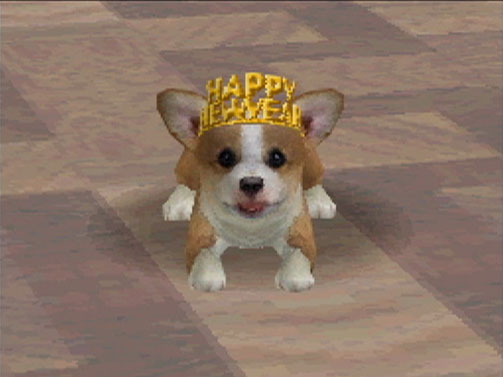
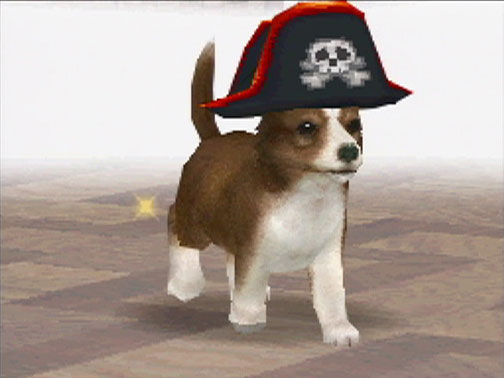
Yes, the Nintendogs are noticeably polygonal. They have data points and textures like any other 3D representation, and at the end of the day they’re still stuck in your DS, behind those double screens. But their behavior is so well done, you’d swear there was a real animal behind those screens. The actions of these puppies is as random and dynamic as a real dog’s; they’ll jump up and paw at the back of the screen when you turn on your DS, like you’ve just come home from work. You feel as if they’re genuinely happy to see you.
The environments are somewhat surreal; a white glow permeates every area and gives them all a comforting, serene atmosphere. But the way the dogs interact with their surroundings is remarkably realistic, whether you’re chilling at home, at the park or out on a casual walk. These places all have a double purpose, as they are training grounds for the contests you can enter your dog into. For instance, the park is great for tossing the frisbee around, your house is better suited for teaching tricks, and the gymnasium is exclusively for agility exercises.
While the scenery is rather unrealistic in some ways, the objects in this world are all very real. I have to hand it to Nintendo; the physics engine in this game is so spot on, and yet so subtle at the same time, you’ll hardly notice it. And that’s the way it should be. Playing fetch with the tennis ball or tug of war with the pull rope should all feel completely natural, so that you forget that you’re playing a game. And it does. Of course, your pet does require some virtual maintenance to keep healthy, such as feeding, cleaning, and exercise, but another beauty of this game is that your puppy will never die. They may get surly and take off for a while if you neglect them, but they remain eternally youthful, never develop debilitating diseases, never run into the street and get hit by a car...it’s all the fun of a puppy without any of the heartbreak.
As I said, the realism of the dogs lies in their personality more than in their appearance. There are twenty breeds in all, each with their own distinct attitudes, likes and dislikes. You get six breeds at the start, and the types depend on which version of the game you bought. All twenty are eventually unlockable, but linking up wirelessly with a friend who has a different version is a more expedient way to complete your list of available breeds.
Once you have your new friend purchased and at home, naming is taken care of with the microphone. Your dogs will actually respond to your voice, be it a simple call of their name or instructions on performing a trick. Thankfully, tapping the screen is just as effective as calling their name, so playing in a public place is possible. As you interact with your dog, he or she will become more accustomed to you and more obedient, and thus more receptive to learning tricks and commands. Some dogs are more stubborn than others, and some of this depends on breed, so be prepared for a training challenge if you pick a rowdy pup.
As you and your pet become more familiar and comfortable, you’ll also grow in confidence. It takes consistent practice in a number of areas, but eventually you’ll be able to enter your dog in competitions. The disc contest is self-explanatory; throw the frisbee and your dog will fetch it. Distance thrown and number of catches within the time limit determines score. Agility trials are a little tougher. You’ll have to train your dog in the gym to leap hurdles, navigate tubes and zigzag through a series of poles.
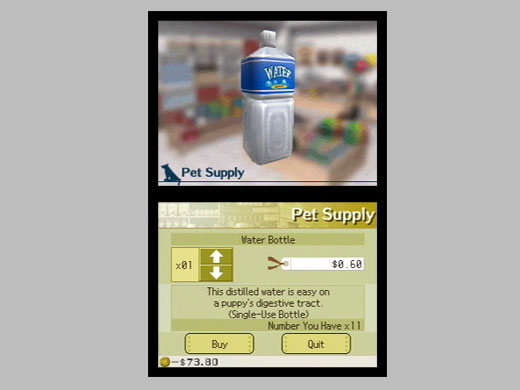
The obedience trials take the most effort. You’ll have to teach your pet a solid list of increasingly complex tricks, and not only that, but they’ll have to do them well and precisely on command too. If you have a particularly inattentive puppy or one that’s easily distracted by a cheering crowd, this contest will be a hard one to beat. All of the trials are worth it, though, as they award you with big prize money. The cash is in turn used to purchase necessities such as food and water, as well as more puppies. You can have eight dogs at one time, three in your home and five in the convenient dog hotel.
In the end, this is all Nintendogs really has to offer. Its relative simplicity makes it easy to pick up and play, but sim fans hoping for a deeper experience may be disappointed. It’s a double-edged sword, really. Non-gamers won’t be intimidated, but the hardcore might consider Nintendogs a little anticlimactic.
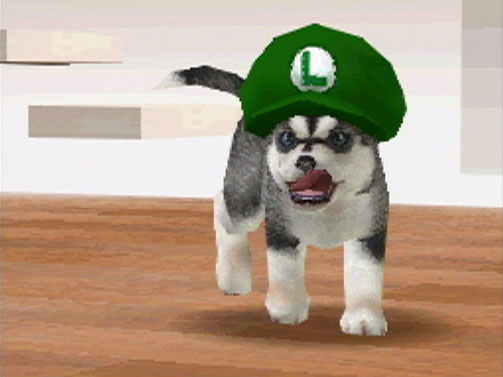
But is the game worth the money? Definitely. There’s still plenty to keep long-time players busy. One of the game’s main attractions is finding items during walks, such as new toys, collars or the ever-popular Mario hat. The wireless “Bark Mode” offers considerable replay value, and an opportunity for virtual dogs and owners alike to play together, swap items and data. Bark Mode will even search for active DS systems in its Bluetooth range, so if you’re in a crowded area you just might find a fellow Nintendogs player.
The core replay value, however, comes from just firing up your DS and interacting with your puppy. If I’m bored I’ll pull out the tennis ball or just scratch my dog behind the ears with the stylus. No matter what, your Nintendog will always be happy to see you.
Rating: 9.2 Class Leading
* The product in this article was sent to us by the developer/company.




About Author
I've been gaming off and on since I was about three, starting with Star Raiders on the Atari 800 computer. As a kid I played mostly on PC--Doom, Duke Nukem, Dark Forces--but enjoyed the 16-bit console wars vicariously during sleepovers and hangouts with my school friends. In 1997 GoldenEye 007 and the N64 brought me back into the console scene and I've played and owned a wide variety of platforms since, although I still have an affection for Nintendo and Sega.
I started writing for Gaming Nexus back in mid-2005, right before the 7th console generation hit. Since then I've focused mostly on the PC and Nintendo scenes but I also play regularly on Sony and Microsoft consoles. My favorite series include Metroid, Deus Ex, Zelda, Metal Gear and Far Cry. I'm also something of an amateur retro collector. I currently live in Westerville, Ohio with my wife and our cat, who sits so close to the TV I'd swear she loves Zelda more than we do. We are expecting our first child, who will receive a thorough education in the classics.
View Profile