Osmos Interview
Written by Charles Husemann on 9/4/2009 for
PC
More On:
Osmos
One of the great things about work on a site like this is you get to talk to new companies with new ideas on gaming. Here is our interview with Hemisphere games and their new game Osmos which is one of the games being showcased in PAX 10 independent developer showcase at PAX this weekend.
Can you introduce yourself and talk about your role on the game?*
I'm Andrew Nealen, a Computer Science professor from Rutgers University. I have been involved in the development of Osmos in one way or the other for the past three years. Recently I have been more of a "spiritual adviser" and evangelist on the project, but I have also dabbled in the code, fiddled with the renderer and mote visualizations, discussed the game mechanics, etc.
What's the history of Hemisphere games? Could you talk about the formation of the company and the core principles of the company?
Hemisphere Games, although not yet named, was shaped long before Osmos started, by my very close friend, collaborator, snowboarding guru and Osmos lead, Eddy Boxerman. The key idea for our game design, and to some extent our core philosophy, is to engage the player with experiences that are not seen in more traditional video games. Ideally, the novelty comes from a small, yet significant change to an established game design. Since we are a small team, we therefore tend to focus on a few specific mechanics, and build the game from there. In the case of Osmos, we built the game around the minimalistic principle of connecting the player's life/size directly to the propulsion.
Could you explain the concept of Osmos for those who aren't familiar with the game or haven't seen any video/pictures of the game?
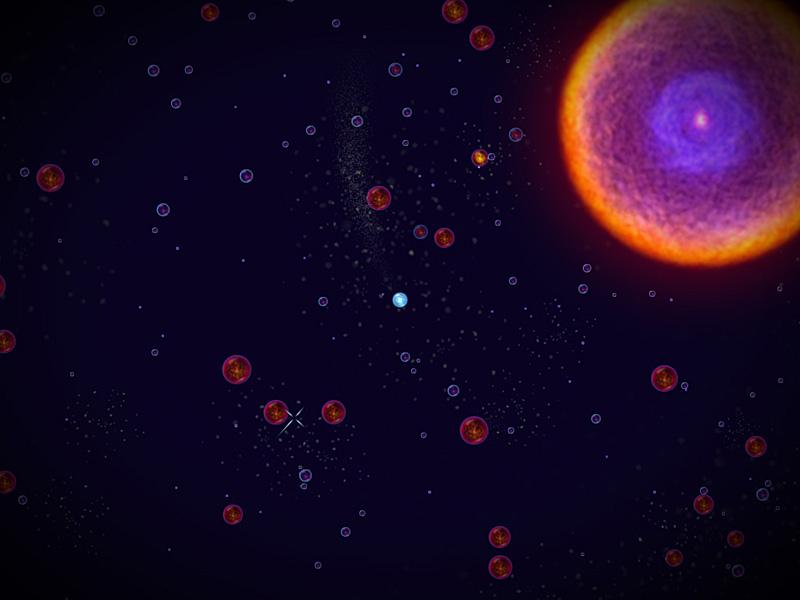
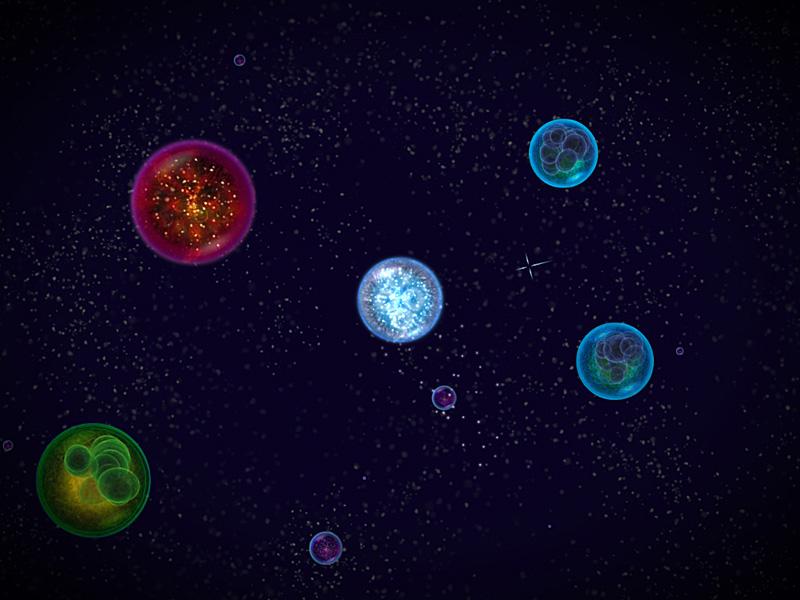
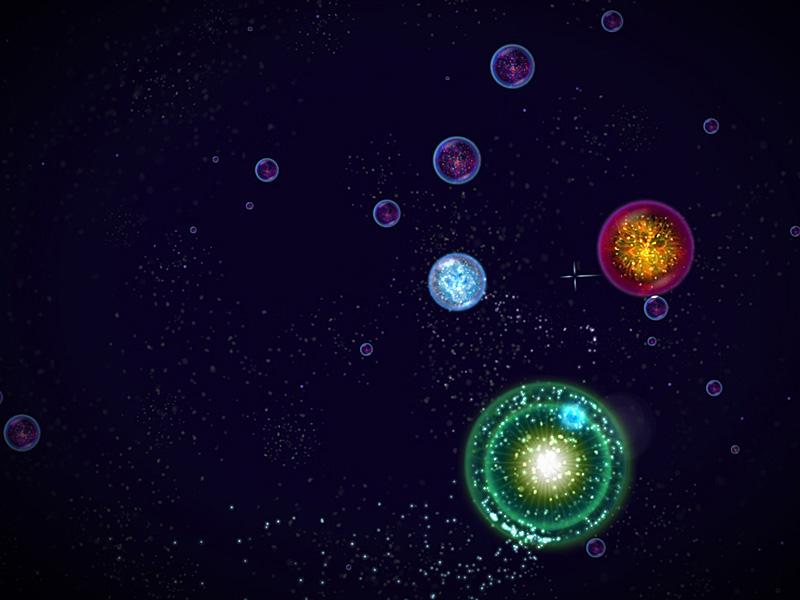
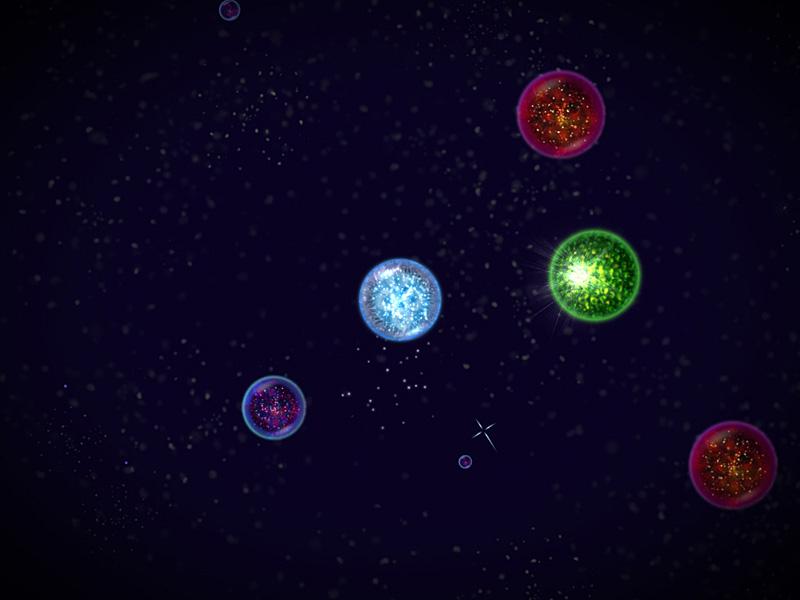
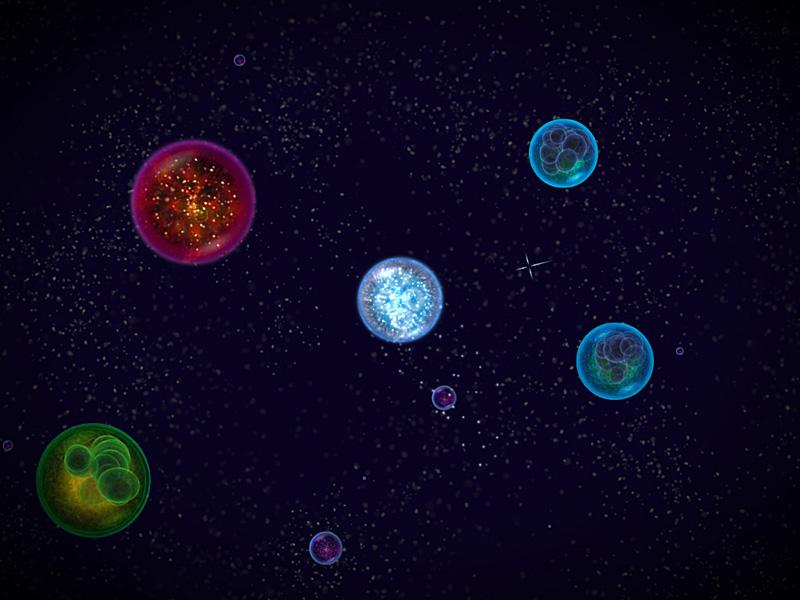
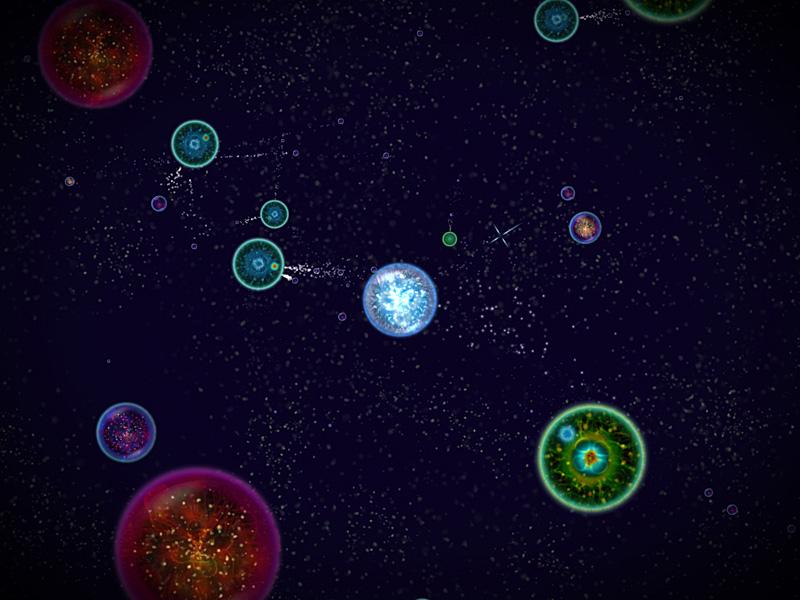
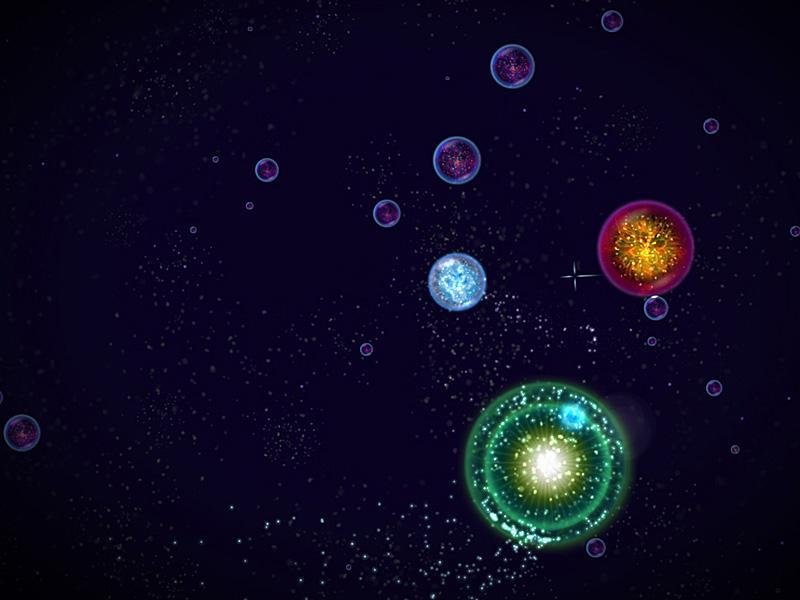
The basic idea is simple: you are a circular being, which we call a "mote", with the desire to grow and become the biggest mote in the (2D) game universe. The only way to grow is by colliding with smaller motes, thereby absorbing them. Collide with a larger mote and you will be absorbed, which leads to "game over". While this might sound like other games, such as flOw, Orbient, or the cell stage of SPORE, there is a significant difference: to propel your mote, you must eject bits of your own matter. Of course, this causes the mote to shrink, but it leads to an interesting trade-off between size and motion. The player must always try to balance size vs. getting to the next smaller mote to absorb. Once this basic game idea was prototyped, we extended the game with centers of gravity, sentient motes with various AI characteristics, antimatter motes, and puzzle-like levels. Add to this the ambient soundtrack and dreamlike visuals of the game, and you have our current vision of an "ambient game".
Are you a self aware galaxy trying to absorb other systems? Are you an amoeba trying to achieve a transcendence into another stage of life? What is it the player controls exactly?
Ah, philosophy. In fact, we intentionally left this ambiguous, and all of the above is potentially true. We all have our take on the various flows in the universe, the trade-offs, karma, etc. It's up to the player to interpret and decide for themselves what Osmos "means". On a very basic level, I like to think of Osmos as "what goes around, comes around".
Is this a case where the music makes the game or just accentuates it? Did you draw inspiration for games like Audiosuf,Rez,and fl0w?
The music is an essential part of Osmos, both from an ambient, as well as from a game mechanics view. The lush soundtrack, ideally, will help the players relax, especially in the ambient stages. But then there are the sound cue's, which are carefully balanced to coincide with key events in the game. For example, many first time players are surprised to see that "absorption" in Osmos is not "binary", and that one can also partially absorb other motes (or be partially absorbed). The sound effect for the absorption was designed with this in mind.
Needless to say, we do not live in a vacuum, and are all avid gamers, so of course games like Rez, flOw and (to a lesser extent) Audiosurf were inspirational. Rez is clearly the high watermark for audio in games, and we can only hope to come close to this masterpiece.
It's easy to create a game that raises the pulse rate, what about creating a mellow like Osmos that's a bit more on the relaxing side?
A very good question. It's surprisingly hard to make a game "relaxing", while at the same time steering clear of "boring". This is most relevant to the "ambient" branch of the game. We like to think that the relaxing and soothing audiovisual atmosphere of Osmos melds well with the meditative, deliberate pace of these levels. Still, we integrated time speed-up for players who can foresee their next steps, and simply want to "fast-forward" to the next critical event. That said, I do not often use this mechanic, and instead simply relax when I have a minute to breathe. One can always switch to the later sentient levels when in need of a faster paced challenge. :)Digital distribution systems seem to be a boon for independent studios, how hard is it to get your game on a system like Steam or Impulse (Did you approach them or did they approach you?)
For us (and many others before us) it was all about the IGF nominations. In this respect, we are deeply indebted to the IGF and the judges for nominating our game in three categories! We had initially approached them (Steam and some others), and there was some interest. But things really got rolling relatively shortly after the IGF nominations. I can wholeheartedly suggest that budding indie developers make great, small (and most importantly playable) games, and submit them to IGF, PAX, Indiecade, and other competitions. Game jams such as TIGJam and the recent Global Game Jam are great too.
What was the hardest part of the game to get working right? What were the lessons learned from the development of the game?
From my point of view, physics and user interface tweaking. The basic prototype of the game was essentially done towards the end of 2006 (!). Then we needed to sit down and do the hard work of making what we thought would be a great game playable for others who had never played it before. As it turns out, tweaking the audio, visuals and controls to work in harmony, such that the player is always aware of what is going on, and not left guessing, is hard, if not the hardest (and imho most important) part of game development. That said, tweaking the first fifteen minutes of the game, which is essential to get the player interested, also took much longer than we had initially anticipated. Lessons learned? Hm. Everything takes 5-10x as long to develop as one thinks, I guess. But this is also where one of the strengths of independent development lies: being able to polish the game mechanics to a shine, and not prematurely release the game. I'm very happy with Osmos in its final state.
Any thoughts about a console/iPhone port of the game?
All is possible. We're thinking Mac/Linux first, but let's see after that. Console, as well as iPhone would be not as straightforward as one might think. Osmos relies heavily on the use of the mouse, and this would need to be mapped to a dual thumb-stick controller, which, while doable, will require some significant play testing. Yes, we are very interested in the iPhone, and the touchscreen would allow us to naturally map the controls, but there we have the added constraint of a significantly lower screen resolution, which will present a challenge when displaying thousands of motes at a time. To be continued...
From your perspective what are the biggest things wrong with the game industry and conversely, what's the best part about working in the industry right now?
I am very positive about where large parts of the game industry are moving. It's a slow process, but I was very impressed with the new IPs introduced by EA in 2008, specifically Mirror's Edge and Dead Space. Yes, these games have their issues, but I enjoyed them, and EA seems willing to take some creative risks. Sure, there's always the curse of the sequels, but if they are as polished as, for example, the Call of Duty franchise, that's fine by me. Of course, I say this wearing my "player" hat. As a developer, I like to have the creative freedom of being indie, for reasons named above, but also for so many others. The most obvious being that we can do whatever we like, model any human condition we like, and at least attempt to think as far outside of the box as possible. I should mention though, that I am in a somewhat luxurious position, being a faculty member with a salary. But both Eddy and Dave are currently full-time indies, so we need to make this financially feasible, if we want to continue along these lines (which we do).
Anything we missed that you think people should know about the game?
Osmos is now available from our website but also from Steam and D2D for $9.99. The game offers 4-8 hours of unique game-play and enjoyment, and significant replayability, which is how we reached the suggested price point. To quote a recent tweet from David Jaffe: "15-20 dollar games, designed to last 1-10 days=magic to me". With this kind of game as an optional branch to the standard AAA, $60 games, we're looking at a bright, creative and compelling future. I see great potential, and I can't wait to see what's next!
Can you introduce yourself and talk about your role on the game?*
I'm Andrew Nealen, a Computer Science professor from Rutgers University. I have been involved in the development of Osmos in one way or the other for the past three years. Recently I have been more of a "spiritual adviser" and evangelist on the project, but I have also dabbled in the code, fiddled with the renderer and mote visualizations, discussed the game mechanics, etc.
What's the history of Hemisphere games? Could you talk about the formation of the company and the core principles of the company?
Hemisphere Games, although not yet named, was shaped long before Osmos started, by my very close friend, collaborator, snowboarding guru and Osmos lead, Eddy Boxerman. The key idea for our game design, and to some extent our core philosophy, is to engage the player with experiences that are not seen in more traditional video games. Ideally, the novelty comes from a small, yet significant change to an established game design. Since we are a small team, we therefore tend to focus on a few specific mechanics, and build the game from there. In the case of Osmos, we built the game around the minimalistic principle of connecting the player's life/size directly to the propulsion.
Could you explain the concept of Osmos for those who aren't familiar with the game or haven't seen any video/pictures of the game?
The basic idea is simple: you are a circular being, which we call a "mote", with the desire to grow and become the biggest mote in the (2D) game universe. The only way to grow is by colliding with smaller motes, thereby absorbing them. Collide with a larger mote and you will be absorbed, which leads to "game over". While this might sound like other games, such as flOw, Orbient, or the cell stage of SPORE, there is a significant difference: to propel your mote, you must eject bits of your own matter. Of course, this causes the mote to shrink, but it leads to an interesting trade-off between size and motion. The player must always try to balance size vs. getting to the next smaller mote to absorb. Once this basic game idea was prototyped, we extended the game with centers of gravity, sentient motes with various AI characteristics, antimatter motes, and puzzle-like levels. Add to this the ambient soundtrack and dreamlike visuals of the game, and you have our current vision of an "ambient game".
Are you a self aware galaxy trying to absorb other systems? Are you an amoeba trying to achieve a transcendence into another stage of life? What is it the player controls exactly?
Ah, philosophy. In fact, we intentionally left this ambiguous, and all of the above is potentially true. We all have our take on the various flows in the universe, the trade-offs, karma, etc. It's up to the player to interpret and decide for themselves what Osmos "means". On a very basic level, I like to think of Osmos as "what goes around, comes around".
Is this a case where the music makes the game or just accentuates it? Did you draw inspiration for games like Audiosuf,Rez,and fl0w?
The music is an essential part of Osmos, both from an ambient, as well as from a game mechanics view. The lush soundtrack, ideally, will help the players relax, especially in the ambient stages. But then there are the sound cue's, which are carefully balanced to coincide with key events in the game. For example, many first time players are surprised to see that "absorption" in Osmos is not "binary", and that one can also partially absorb other motes (or be partially absorbed). The sound effect for the absorption was designed with this in mind.
Needless to say, we do not live in a vacuum, and are all avid gamers, so of course games like Rez, flOw and (to a lesser extent) Audiosurf were inspirational. Rez is clearly the high watermark for audio in games, and we can only hope to come close to this masterpiece.
It's easy to create a game that raises the pulse rate, what about creating a mellow like Osmos that's a bit more on the relaxing side?
A very good question. It's surprisingly hard to make a game "relaxing", while at the same time steering clear of "boring". This is most relevant to the "ambient" branch of the game. We like to think that the relaxing and soothing audiovisual atmosphere of Osmos melds well with the meditative, deliberate pace of these levels. Still, we integrated time speed-up for players who can foresee their next steps, and simply want to "fast-forward" to the next critical event. That said, I do not often use this mechanic, and instead simply relax when I have a minute to breathe. One can always switch to the later sentient levels when in need of a faster paced challenge. :)Digital distribution systems seem to be a boon for independent studios, how hard is it to get your game on a system like Steam or Impulse (Did you approach them or did they approach you?)
For us (and many others before us) it was all about the IGF nominations. In this respect, we are deeply indebted to the IGF and the judges for nominating our game in three categories! We had initially approached them (Steam and some others), and there was some interest. But things really got rolling relatively shortly after the IGF nominations. I can wholeheartedly suggest that budding indie developers make great, small (and most importantly playable) games, and submit them to IGF, PAX, Indiecade, and other competitions. Game jams such as TIGJam and the recent Global Game Jam are great too.
What was the hardest part of the game to get working right? What were the lessons learned from the development of the game?
From my point of view, physics and user interface tweaking. The basic prototype of the game was essentially done towards the end of 2006 (!). Then we needed to sit down and do the hard work of making what we thought would be a great game playable for others who had never played it before. As it turns out, tweaking the audio, visuals and controls to work in harmony, such that the player is always aware of what is going on, and not left guessing, is hard, if not the hardest (and imho most important) part of game development. That said, tweaking the first fifteen minutes of the game, which is essential to get the player interested, also took much longer than we had initially anticipated. Lessons learned? Hm. Everything takes 5-10x as long to develop as one thinks, I guess. But this is also where one of the strengths of independent development lies: being able to polish the game mechanics to a shine, and not prematurely release the game. I'm very happy with Osmos in its final state.
Any thoughts about a console/iPhone port of the game?
All is possible. We're thinking Mac/Linux first, but let's see after that. Console, as well as iPhone would be not as straightforward as one might think. Osmos relies heavily on the use of the mouse, and this would need to be mapped to a dual thumb-stick controller, which, while doable, will require some significant play testing. Yes, we are very interested in the iPhone, and the touchscreen would allow us to naturally map the controls, but there we have the added constraint of a significantly lower screen resolution, which will present a challenge when displaying thousands of motes at a time. To be continued...
From your perspective what are the biggest things wrong with the game industry and conversely, what's the best part about working in the industry right now?
I am very positive about where large parts of the game industry are moving. It's a slow process, but I was very impressed with the new IPs introduced by EA in 2008, specifically Mirror's Edge and Dead Space. Yes, these games have their issues, but I enjoyed them, and EA seems willing to take some creative risks. Sure, there's always the curse of the sequels, but if they are as polished as, for example, the Call of Duty franchise, that's fine by me. Of course, I say this wearing my "player" hat. As a developer, I like to have the creative freedom of being indie, for reasons named above, but also for so many others. The most obvious being that we can do whatever we like, model any human condition we like, and at least attempt to think as far outside of the box as possible. I should mention though, that I am in a somewhat luxurious position, being a faculty member with a salary. But both Eddy and Dave are currently full-time indies, so we need to make this financially feasible, if we want to continue along these lines (which we do).
Anything we missed that you think people should know about the game?
Osmos is now available from our website but also from Steam and D2D for $9.99. The game offers 4-8 hours of unique game-play and enjoyment, and significant replayability, which is how we reached the suggested price point. To quote a recent tweet from David Jaffe: "15-20 dollar games, designed to last 1-10 days=magic to me". With this kind of game as an optional branch to the standard AAA, $60 games, we're looking at a bright, creative and compelling future. I see great potential, and I can't wait to see what's next!
* The product in this article was sent to us by the developer/company.



About Author
Hi, my name is Charles Husemann and I've been gaming for longer than I care to admit. For me it's always been about competing and a burning off stress. It started off simply enough with Choplifter and Lode Runner on the Apple //e, then it was the curse of Tank and Yars Revenge on the 2600. The addiction subsided somewhat until I went to college where dramatic decreases in my GPA could be traced to the release of X:Com and Doom. I was a Microsoft Xbox MVP from 2009 to 2014. I currently own stock in Microsoft, AMD, and nVidia.
