For as long as I can remember, my father (and his father
before him) have been big horse racing fans.
In fact, for the last 20 years or so, my dad has bred and raced Standard
bred harness racers. Harness racing, for
those that aren't familiar with the
term, are the ones that pull cart (called a sulky) behind the horse rather than
have a jockey on the horse's
back. The type of racing that involves a
relatively small, light weight person clinging to the back of the horse and
holding on for dear life is known as Thoroughbred racing. At this point, you are more than likely
thinking, "Gee, that's
fascinating, but why are you telling me this?
Well, I'll tell
you. In the extremely crowded market of
console-based sports games, there are very few that break from the mainstream
stick, ball, and/or puck pursuits and delve into some of the niche sports such
as horse racing. Bethesda Softworks is
one of those that is willing to push the boundaries and explore new
opportunities. An example of this is the
recently released Breeders' Cup World Thoroughbred Championships for the
Xbox. While it is not harness racing, it
is close enough to have piqued my interest, so I decided to take a look at it.
As is the case in many sports, the horse racing enthusiast
can choose to concentrate on certain aspects of the sport, or go the whole hog
and participate in all aspects. In horse
racing this means one can simply buy a horse and race it, or go the full route
of breeding, training, and racing a horse.
Breeders Cup supports both
choices. As in many console games, you
can choose a quick play mode, or you can dig down into the esoteric details
that truly give a sport its long-term challenge and interest.
With horse racing, it all comes down the breeding. Volumes and volumes of historical data
pertaining to the lineage and race performance of horses are perused in an
attempt to find the perfect sire/dam combination that will result in a
race-winning foal. As with any pursuit
of this nature, however, there are no guarantees. A mating that looks great on paper may or may
not result in a horse that will perform as desired. This is, of course, the reason they actually
put the horses on the track and race them, and is what provides the addictive
nature of horse racing to its participants.
Hey, if it was easy everyone would be doing it!
Breeders Cup
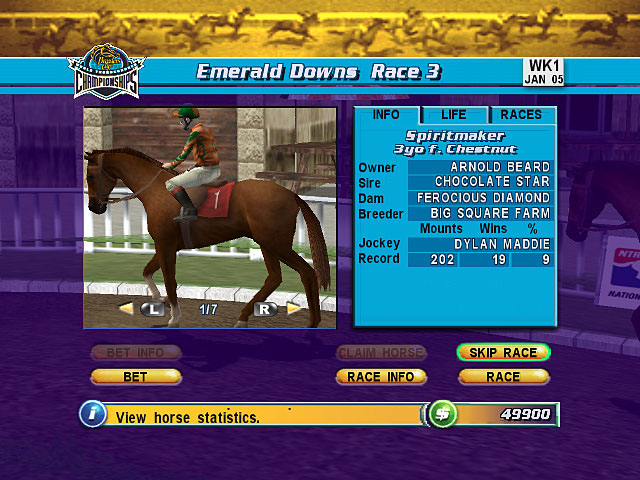
starts you off with an empty six horse stable and a little bit of cash. It is up to you to decide how to populate the
stable and determine the strategy for growing your racing dynasty. There are three possible approaches:
acquisition of already racing horses through claiming races (races in which
every horse entered can be bought, or "claimed," for a stated price),
breeding, or a combination of the two.
Claiming a horse has the benefit of being able to base a purchase
decision on known performance, while breeding offers the opportunity to try to
tailor the resulting race horse to your favored track type, race type, and
horse disposition.
Track types can be dirt or turf. Race types can be sprints, medium length, or
long. Horse disposition is a combination
of factors such as speed, strength, running style, and temperament that will
determine the best way to race the horse.
For example, a horse with a lot of strength will fare better in long
races than a horse that can sprint well but hasn't
the strength for a long race. A horse
with good temperament will perform better racing in a tight pack of horses,
while a horse with poor temperament will likely perform better as a front
runner where it needn't be in close
contact with the rest of the racers.
Other important factors are the fitness, fatigue, and injuries. Fitness, achieved through specific training
regimens, will allow for higher stamina and less chance of injury. Fatigue, resulting from too much racing, will
result in a poorly performing race.
As the stable owner, it is your responsibility to manage
the training and race schedule of your horses to ensure that they are
adequately prepared for the strenuous life a race horse leads. As in most sporting endeavors, there is a
delicate balance between racing aggressively and racing irresponsibly. Push your horses too hard, and you will end
up with a stable full of injured horses.
Injured horses continue to consume dollars through boarding and
training, but cannot bring dollars back via race winnings. As a stable owner, you have to watch the
balance sheet every bit as closely as you watch the race sheets.
If all of that seems too much effort and you'd prefer to just "arrive and drive," you
will be more interested in the Quick Race mode.
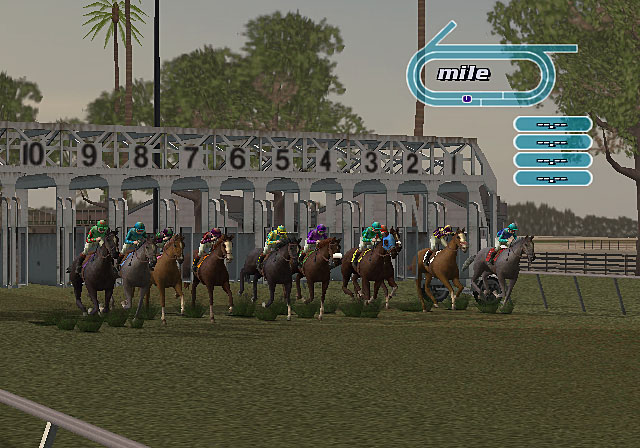
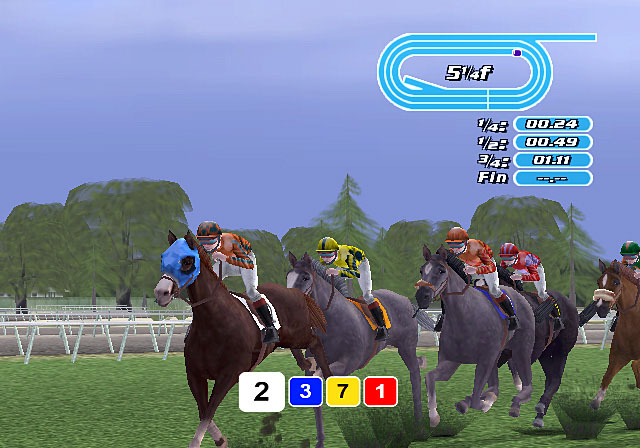
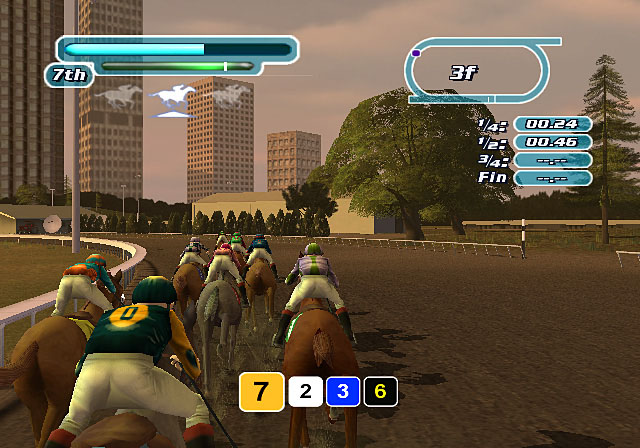
This allows you to choose a horse from the lineup that you will
ride. The race starts in the starting
gate, and as the gates open, you will find yourself astride a galloping
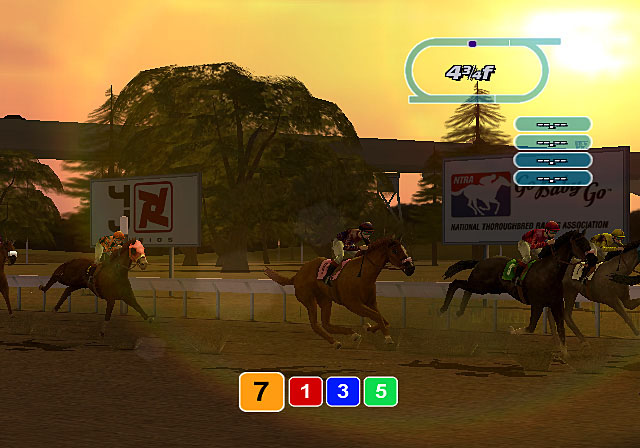
beast. As the rider, you can
"steer" the horse to the rail, or stay a little outside to ensure a
clear route to pass. You can encourage
your horse to run at the front of the pack, or hang back with the crown in the
hopes of preserving strength for a sprint to the finish. As the race nears the finish line, you can
further encourage your horse through the use of a whip. To improve your chances of winning, you
should consider the preferred racing style of your chosen mount, although it is
possible to win by simply ignoring all of the subtle strategies and just
flogging your horse mercilessly. Since
this is a single race mode, you don't
have to worry about the costs in fatigue and injury that would normally be
incumbent in such an approach. This, to
me, made the Quick Race mode far less interesting than it could have been.
Also of interest to the "arrive and drive" type
of player would be the multiplayer mode.
This mode allows two players to enter into a race and race against each
other and the computer-controlled pack of other horses. Multiplayer mode does not use a split screen,
though. Instead, the camera attempts to
show both player's horses until one
of the players falls back too far. At
that point the camera stays with the leading player and the computer takes over
in driving the lagging horse. This is far
less than optimal as once the lagging player loses controls of his horse, he
has no hope of catching up. This results
in essentially requiring both players to use a sprint race strategy since the
player that chose the strategy of staying with the pack and making a string
finish will almost immediately lag behind, lose control of his horse, and get
whipped like a rented mule. Without the
aspect of strategic and tactical planning, the racing becomes pretty boring. What would probably have worked better for
multiplayer would have been Xbox Live support, although given the niche aspect
of the game there may have been some challenge involved in getting together
enough players to have an interesting race.
Because of these limitations in the quick race and
multiplayer modes, Breeders Cup will
be satisfying mostly for the players that are interested in the full aspects of
horse racing, at least in so far as interactive play goes. There is one other aspect to horse racing
that I have not yet mentioned: betting.
For those that enjoy scanning the past performance of the entrants in
any given race, combined with the historical performance of the jockies and the
prevailing race conditions in an attempt to determine who will win and place
bets accordingly, Breeders Cup
offers the opportunity to do so in your own home, albeit with fake money. Of course, as with anything involving money,
there is a fair degree of complexity involved.
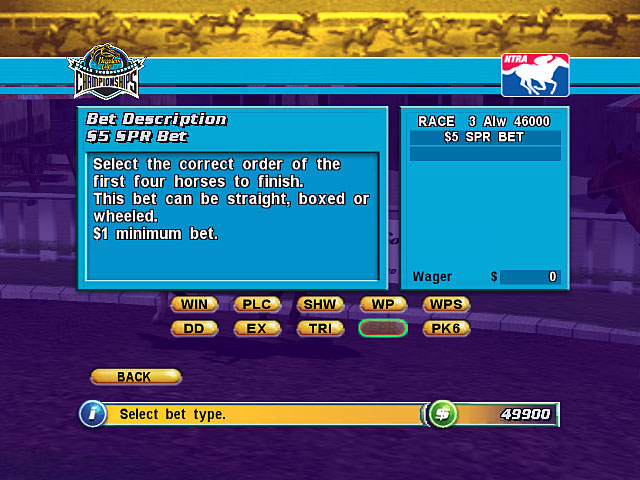
You can choose to make simple bets like Win, Place, or Show, or you can
expand into somewhat more exotic betting types like the Exacta, Trifecta, or
Superfecta. As the complexity and risk
increase, so do the potential winnings.
If all of that isn't
confusing enough, you can choose to bet Straight, Boxed, or Wheeled. When it comes to betting on horse races,
there are many ways to choose your poison.
All in all, Breeders
Cup gives a nice introduction to the sport of horse racing, but only those
willing to truly dive in and concern themselves with the more complex aspects
of the game will be satisfied. Those
that just want to climb onto the back of a horse and race will be left wanting
more of a challenge.